Peking University HSBC Business School (PHBS) hosted its inaugural Workshop on International Economics on October 19, 2026, bringing together scholars from Yale University, the University of California, San Diego, and PHBS to discuss research in international trade, spatial economics, and macroeconomic policy.

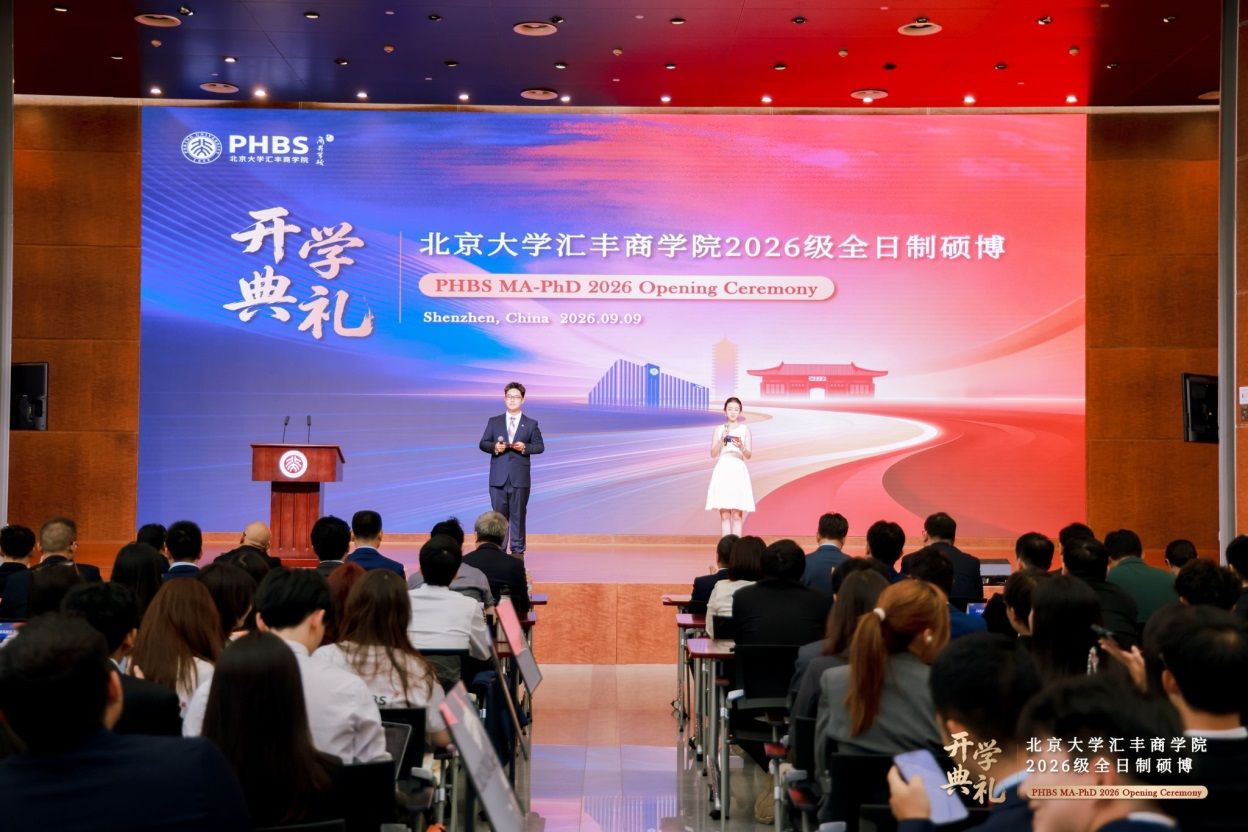
Wang Pengfei delivers the opening remarks
Wang Pengfei, Boya Distinguished Professor at Peking University and dean of PHBS, delivered the opening remarks. He introduced the history and development of PHBS since its founding and provided an overview of the school's faculty, expressing the hope that the workshop would become a high-level platform for sustained academic exchange between PHBS and scholars around the world.

From left to right: Costas Arkolakis and Jia Ruixue
Costas Arkolakis, professor of economics at Yale University, delivered a keynote titled "The Geography of Fertility: Theory and Evidence from South Korea." Drawing on South Korean census data, credit bureau records, mobile-phone mobility data, and government administrative microdata, the study develops a dynamic spatial equilibrium model linking household residential choices, fertility decisions, and investments in children’s education. It examines how housing costs, commuting costs, and education spending shape fertility across regions. The findings suggest that high housing and commuting costs in major cities, together with intensive investment in children’s education, contribute to lower fertility. Counterfactual analysis suggests that city-specific policies may have limited effects as households relocate, while nationwide reductions in the costs of childbearing and childrearing could be more effective.
Jia Ruixue, professor of economics at the School of Global Policy and Strategy, University of California, San Diego, delivered a keynote titled "State Simplification and Market Distortion: Evidence from a Millennium of Chinese Salt Administration." Using China's salt monopoly as a case study, the research examines how administrative simplification for taxation and regulation can distort markets. Drawing on a new panel of county-level salt output from 960 to 1920 and boundary changes across five dynasties, the study finds that rigid production and sales zones and restrictions on cross-zone trade meant that production locations were shaped by administrative market access rather than general market access. A spatial model of the monopolistic state is used to quantify the resulting misallocation and efficiency losses.

From left to right: Li Zhimin, Ma Xiao, Wang Jiaxin, and Li Yiliang
The workshop also featured four paper presentations by PHBS researchers. Li Zhimin, tenured associate professor at PHBS, presented his paper titled "Twin Flows: Capital Mobility and Labor Reallocation in a Dynamic Spatial Model." The paper develops a dynamic spatial economic model that incorporates interregional capital mobility and labor reallocation into a unified analytical framework, investigating how capital flows influence regional employment and resource allocation, as well as how labor migration in turn affects capital allocation and regional economic development.
Ma Xiao, assistant professor at PHBS, presented his coauthored paper titled "Comparative Advantage and Economies of Scale Under Uncertainty." Using data on U.S. commuting zones and international trade, the study develops a multi-sector spatial equilibrium model incorporating industry-level economies of scale, macroeconomic uncertainty, and workers' migration decisions. The findings show that uncertainty induces workers to relocate toward industries and regions with lower risks, reducing aggregate gains from trade in the United States by at least one-third compared with a benchmark economy without uncertainty.
Wang Jiaxin, a PhD student in the class of 2023 at PHBS, introduced the coauthored paper titled "Trade War, the Dollar, and Welfare." The paper examines how U.S. import tariffs affect Treasury bond convenience yields, the dollar, and welfare. Higher tariff revenues strengthen fiscal backing for nominal liabilities, putting upward pressure on the dollar, while reduced cross-border trade and lower demand for dollar-denominated trade financing put downward pressure on it. A calibrated two-sided model explains why tariff shocks resembling the “Liberation Day” announcements weaken the dollar.
Li Yiliang, assistant professor at PHBS, presented the coauthored paper titled "Shipping to America." The study examines the macroeconomic and trade-policy implications of disruptions to shipping routes to the United States. It uses satellite vessel-tracking data to construct route-level indicators of potential and effective shipping capacity, which are incorporated into a general equilibrium model. Firms reallocate shared fleets but do not internalize the congestion they cause, charging prices above marginal costs, while importers adjust procurement according to route profitability. Tariffs can ease congestion on taxed routes, offsetting or even reversing their conventional welfare costs.

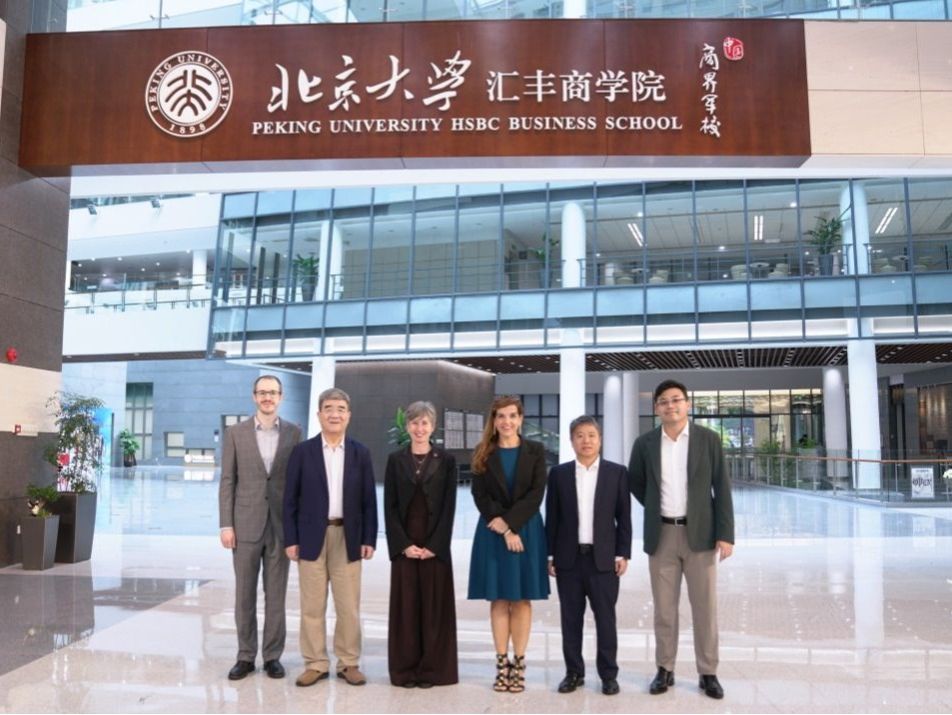
The group photo of participants
Over a single day, the workshop spanned topics from fertility decisions across South Korea to a millennium-long study of Chinese salt administration, as well as tariff-driven shifts in the dollar and congestion on U.S.-bound shipping routes. Through academic events of this kind, PHBS will continue to advance frontier research and promote international academic exchange, deepening understanding of the global economy and its evolving challenges.
By Annie Jin, Chen Chenxuan, and Wang Luhang
Source: Research Office and PR& Media Office