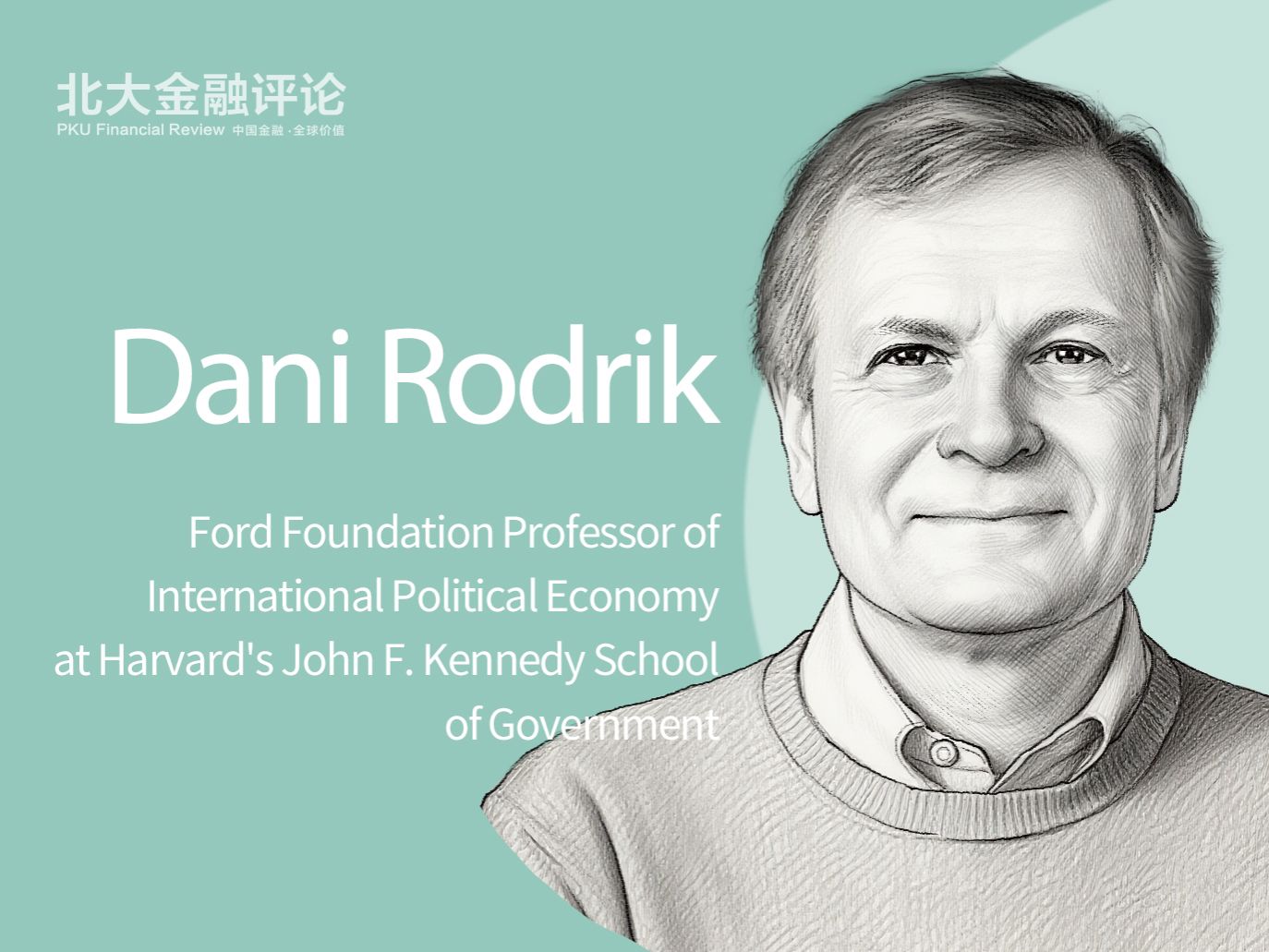
Dani Rodrik (born August 14, 1957, in Istanbul, Turkey) stands as one of the most influential economists of our time. He currently holds the Ford Foundation Chair in International Political Economy at Harvard University's John F. Kennedy School of Government, with his research deeply rooted in three core domains—international economics, economic development, and political economy. Through his incisive critiques of globalization, pioneering rethinking of industrial policy, and forward‑looking theories on global governance reform, Rodrik has not only reshaped the conventional understanding of economic development but also expanded beyond the orthodox paradigms of mainstream economics. Throughout his career, he has maintained a productive distance from doctrinal orthodoxy. He wields the analytical tools of his discipline with masterful skill, keenly discerning their inherent limitations, and embraces with intellectual generosity the vast diversity of economic institutions across the globe. For the depth of his thought and the breadth of his real‑world impact, he is widely hailed in the global economics community as "a scholar whose achievements are worthy of a Nobel Prize, even if the Nobel has yet to arrive."
Interview with Prof. Rodrik
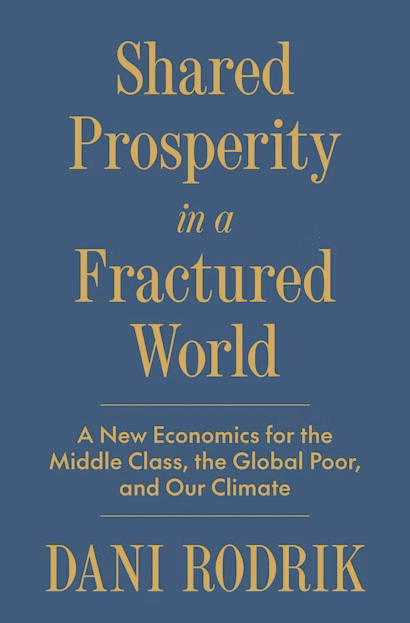
PKU Financial Review: In your new book Shared Prosperity in a Fractured World: A New Economics for the Middle Class, the Global Poor, and Our Climate, you argue that the world today faces three urgent challenges: tackling climate change, saving democracy, and eliminating poverty. What do you see as the key tradeoffs between these three goals, and why do traditional policies often end up addressing one at the expense of the others?
Dani Rodrik: I think in the minds of many policymakers there are tradeoffs that, as I explain in the book, either don't exist or are significantly attenuated by existing technological conditions. For example, many Western countries think that the only way to restore their middle class and create good jobs is to reinvigorate manufacturing and reshore production. But as I argue, manufacturing is no longer a source of job creation. So if we are really looking at how to address the frailty of the middle class, their anxieties, and the problem of good jobs, we have to turn to services—many of which are non‑traded. The usual tension between protecting domestic manufacturing and what that does to other countries' exports or development prospects really doesn't exist if we recognise that the path to a cohesive society and a strong middle class no longer goes through manufacturing.
Another false tension concerns climate change. We put a lot of focus on global cooperation and governance, and it is true that emissions don't respect borders. But what we have learned from the last 10‑15 years of technological innovation and green industrial policies—especially China's policies in solar, wind, and electric vehicles—is that national action and national interest can be reformulated to promote the kind of technological innovation critical for the green transition. So we can make significant progress without necessarily relying on global agreements, if countries understand that the green transition is a structural transformation they must undertake for their own benefit, with significant national gains. These are two critical examples where many policymakers see tensions, but the reality is more optimistic.
PKU Financial Review: You propose a new paradigm of "productivism" in your book. This seems countercurrent in a service‑dominated era. Why emphasise production, and how would you respond to critics who see this as merely a rebranding of old‑style industrial policy?
Dani Rodrik: Actually, what I mean by productivism does not apply only to goods. As my previous comments indicate, I am especially focused on increasing productivity in services. So the concept of productivism is applied throughout the book to services—whether it is long‑term care, retail, and food services in advanced countries, or platforms, SMEs, and informal activities in developing countries. I focus on productivity because the only way we can create good jobs and economic opportunity in those sectors is to increase productivity broadly: reducing costs, improving quality, and offering more customised services. That requires organisational changes—for example, how we organise the care sector in advanced countries, or how we deploy platforms and gig work in developing countries—combined with new, more labour‑friendly technologies.
I do think governments need to have a hand in this process; markets alone will not produce the right technologies or outcomes for most workers. So in that sense it is a kind of industrial policy—governments have to put their thumb on the scale—but it is very much oriented towards services, which is where the bulk of jobs will be.
PKU Financial Review: Manufacturing's role as an escalator for economic growth is weakening, as automation and global competition reduce factories' capacity to absorb large‑scale labour. What implications does this trend hold for China, and how do you assess China's manufacturing‑driven development model over the past decades?
Dani Rodrik: Clearly the model has worked very well for Japan and for China. China's experience is one of the most significant economic miracles in history—not just growth, but enormous poverty reduction. Much of that came from manufacturing's role as an escalator, bringing workers from the countryside onto assembly lines. But China is also showing the strains of this model and how it is coming to an end. Paradoxically, China made it much more difficult for many other countries to embark on that escalator because it became a hyper‑competitive manufacturing superpower, contributing to premature deindustrialisation in middle‑ and low‑income countries.
Today, China itself faces a version of this problem. Even though output and exports continue to expand, manufacturing employment in China is declining very rapidly. So the question is: what happens to the labour market? How do we create meaningful, high‑quality, well‑paying jobs in services for the bulk of young people—both college‑educated and less so—in China? Those jobs will not be in manufacturing. If we don't want a dual economy where a small share of the labour force works in high‑productivity manufacturing, we need to extend the Chinese model—which has done extremely well in manufacturing—to services. Part of that transition is that many of these services serve the domestic market and are non‑tradable, which fits with China's shift toward an economy more oriented to domestic demand, where consumption plays a larger role and very high savings are moderated.

PKU Financial Review: In 2022, you co‑authored a piece in Foreign Affairs with Stephen Walt calling for the US to acknowledge hegemonic decline and cooperate with China to build a benign global order. More than three years on, geopolitical tensions have intensified. In today's zero‑sum world, where does hope lie for great‑power cooperation, and does the "meta‑regime" framework you proposed remain feasible?
Dani Rodrik: Unfortunately, today we are very far—much further away—from the kind of cooperative meta‑regime that Walt and I described. A fundamental premise of that regime is that both the US and China understand we are moving into a multipolar world, not a unipolar one; that there is no point in trying to achieve hegemony; and that the US and China are not the only decision‑makers—middle powers and regions like Europe, Brazil, Indonesia, South Africa, and India are particularly important. We need rules determined by a wider group of actors, and we need to find terms for such an accommodation.
We are very far from that regime because, under Trump, the United States has moved in a completely counterproductive direction. If there is a silver lining, I would say that the negative consequences of Trump's actions—whether in relations with traditional allies like the Europeans or his recent war against Iran—are so obvious that perhaps a new US administration might understand that sheer assertion of power and the desire to return to a world where the US alone sets the rules is no longer feasible. Maybe today's disaster could open the door for a better outcome.