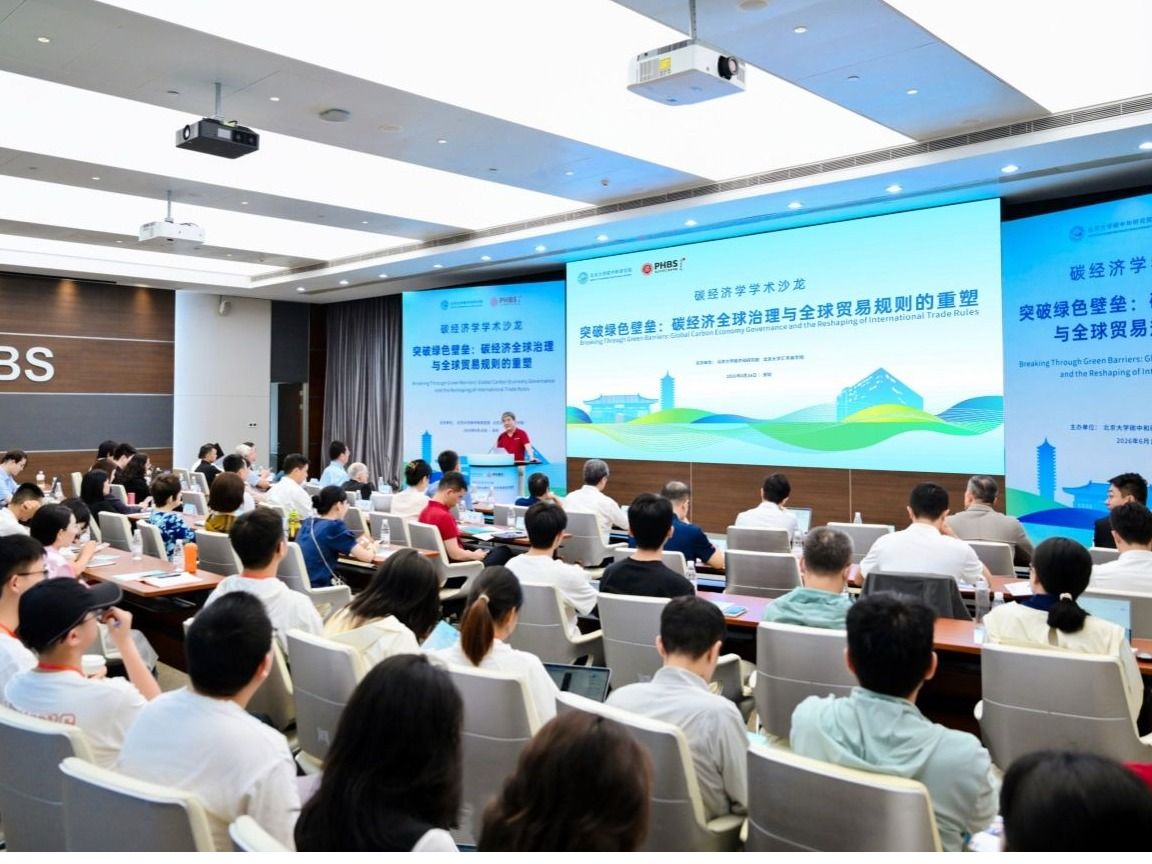
The PHBS UK Conference on the Frontiers of AI in Economics was held on May 15, 2026, at Peking University HSBC Business School (PHBS) UK Campus in Oxfordshire. The conference brought together over 40 renowned scholars from the United Kingdom, the United States, Italy, Germany, Switzerland, Hong Kong, and other regions to explore how artificial intelligence is reshaping global financial systems and economic theory.

Conference venue
Domenico Tarzia, assistant professor at PHBS and deputy director of PHBS UK Campus, delivered the opening address. He welcomed scholars from economics, finance, and statistics, expressing his hope that the rigorous discussions would generate new ideas and foster more interdisciplinary and cross‑regional academic collaboration.

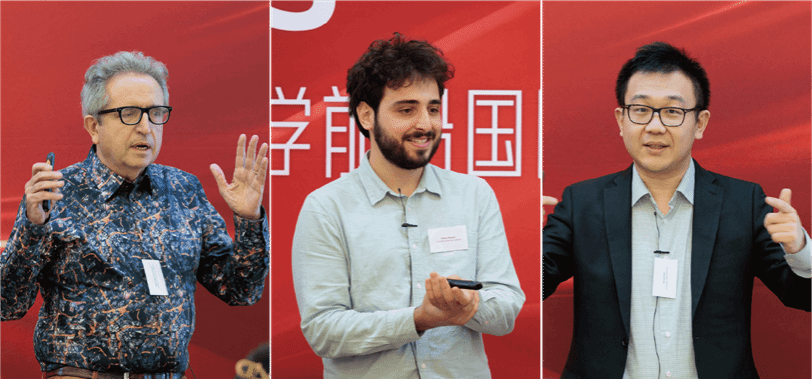
From left to right: Domenico Tarzia, Thomas J. Sargent, and Wang Pengfei
Thomas J. Sargent, 2011 Nobel laureate in economics, honorary director of the PHBS Sargent Institute of Quantitative Economics and Finance at PHBS (SIQEF) and W.R. Berkley professor of economics and business at New York University, delivered a keynote titled “Einstein as Machine Learner.” He interpreted major scientific breakthroughs as processes of recognizing patterns, compressing complex information, and forming generalizable rules — linking machine learning not just to modern computation but to a long tradition of scientific reasoning that moves from observations to functions, models, and theories. The talk connected human intelligence, AI, statistics, and the limits of intuition, suggesting that AI should be seen as a framework for rethinking knowledge production, not merely a prediction tool. Participants discussed whether AI can generate original theories, how learning enters economic models, and how machine intelligence may complement or challenge human reasoning.
From left to right: Ramon Marimon, Matteo Muntoni, and Winston Wei Dou
Ramon Marimon and Matteo Muntoni presented their collaborative papers titled “What have We Learned from Macro-learning then and What can We Learn from Macro-AI now?” and " AI-generated Expectations and Market Stability." They placed LLM forecasting agents in a macroeconomic model with multiple possible equilibria, examining how information, memory, and external signals affect expectation formation. Generative AI agents can reproduce human‑like forecasting patterns, but their behavior is highly sensitive to model capability, memory structure, and experimental design. The discussion explored whether AI agents can represent human subjects, how memory should be modeled, and whether AI participation may amplify market volatility.
Winston Wei Dou presented a paper titled “Human Edge, Machine Limits: Algorithmic Herding and AI-Human Competition in Financial Markets.” In a framework where AI investors compete with humans of varying cognitive levels, humans possess private information but bounded reasoning, while AI learns via reinforcement learning. Sophisticated humans may still outperform AI because AI learns from average (not frontier) human behavior. AI profitability is limited by human private information, price‑stabilizing traders, and rising price impact as AI market share expands. The talk raised questions about algorithmic herding, AI trading regulation, and financial stability.
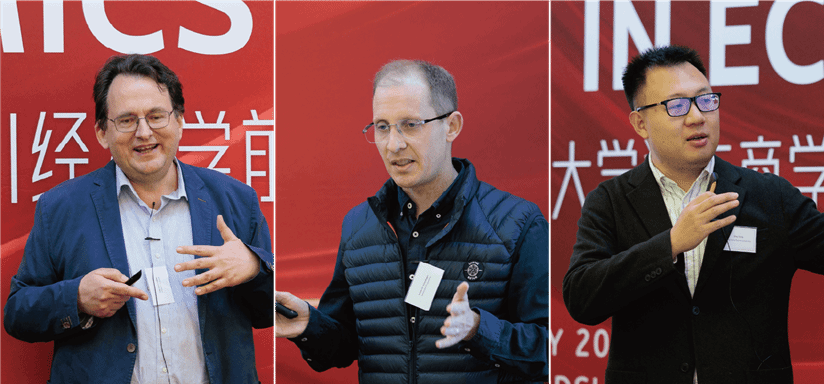
From left to right: Felix Kübler, Simon Scheidegger, and Dong Ding
Felix Kübler presented a paper titled “Bayesian Optimization on the Equilibrium Manifold.” The method combines Bayesian optimization with equilibrium manifold constraints to search for optimal policies within the feasible set defined by equilibrium conditions, rather than treating the model as a black box. Compared to grid search or full‑model solutions, Bayesian optimization uses surrogate models and uncertainty assessment to decide where computation is most valuable. The approach is relevant for computational economics, general equilibrium, and portfolio choice, highlighting how machine learning becomes more powerful when disciplined by economic theory.
Simon Scheidegger presented a paper titled “Using Machine Learning to Compute Constrained Optimal Carbon Tax Rules.” The paper uses machine learning to solve a carbon tax design problem in a model with twelve overlapping generations, stochastic carbon intensity, temperature dynamics, and tipping‑point risk. Methodologically, it combines Deep Equilibrium Networks, Gaussian‑process surrogate modeling, and Bayesian active learning. A simple cumulative‑emissions tax with optimal transfers yields a Pareto‑improving welfare gain of about 0.42% in consumption equivalents; adding more complex tax bases (carbon intensity, tipping points) raises the gain only modestly to 0.45%. The discussion focused on government commitment and policy applicability.
Dong Ding presented a paper titled “Experimental Macro with LLM Agents of Bounded Rationality: with an Application to the Fiscal Theory of the Price Level.” The paper creates a general‑equilibrium laboratory where LLM agents operate within a structurally disciplined macroeconomic environment. A beauty‑contest game shows LLM agents exhibit level‑k reasoning similar to humans. In overlapping‑generations monetary economies, LLM agents can coordinate on low‑inflation equilibria, while narrative shocks may lead to higher inflation when fiscal fundamentals are weak. Credible reforms that reduce both the mean and volatility of deficits have durable disinflationary effects; cosmetic reforms are only temporary. Discussion covered context, narratives, credibility, and prompt design.
In his closing remarks, Wang Pengfei, Boya distinguished professor at Peking University and dean of PHBS, thanked Professor Thomas J. Sargent, all presenters, participants, the organizing team, and volunteers. He noted that the conference addressed cutting‑edge topics with in‑depth discussion, making it highly engaging. He introduced the PHBS UK Campus and the school’s internationalization efforts, and extended an invitation to scholars to visit Shenzhen, expressing his hope for continued international academic exchange.
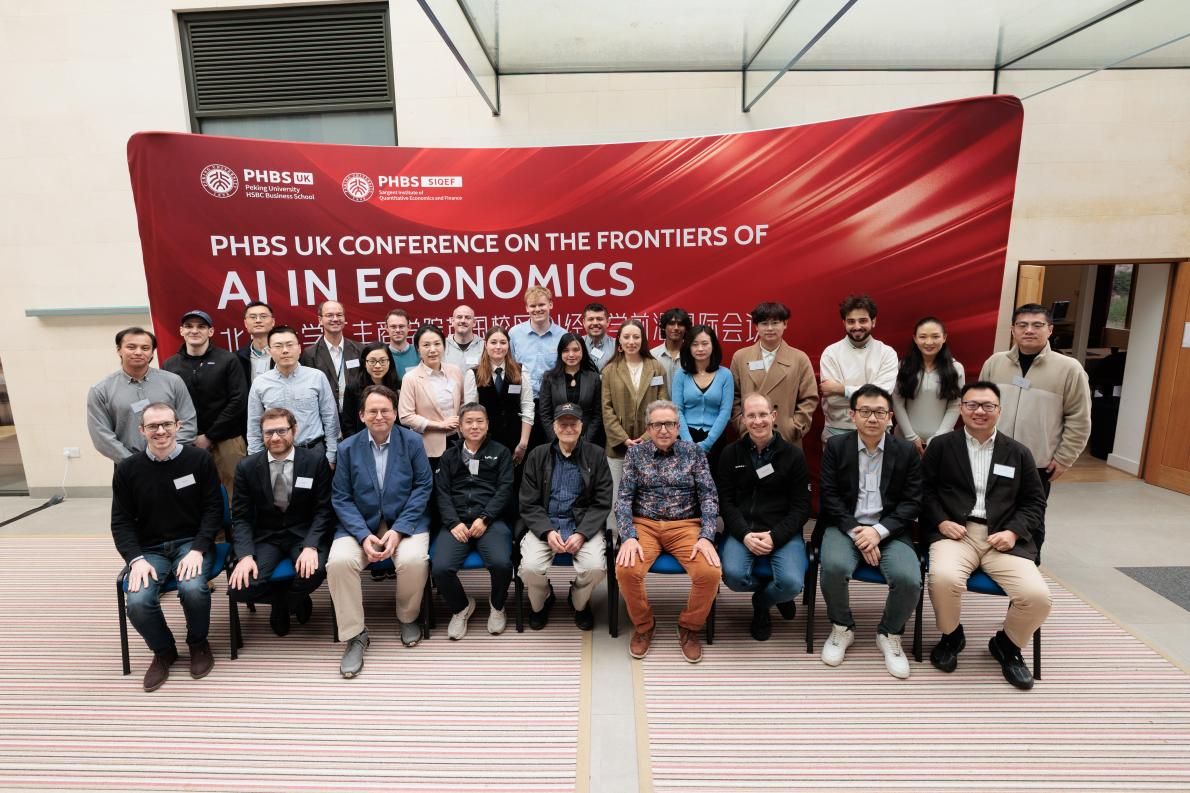
Group photo of some participants
The conference was jointly organized by SIQEF and the PHBS UK Campus and moderated by Shi Jiao, associate professor at PHBS and deputy director of SIQEF. As a key event in PHBS UK’s international academic exchange activities, the conference embodied the principle of “Academic Dialogue, Global Vision,” showcasing the latest research on the integration of AI and economics and providing a high‑level platform for intellectual exchange. Moving forward, PHBS will continue to leverage its global presence to promote frontier research and international collaboration, contributing wisdom and strength to economic innovation in the age of artificial intelligence.
By Annie Jin, Lei Sijie, and Shi Chenglong
Source:SIQEF, UK Campus, and PR & Media Office